Disconnectors are switching facilities that can switch only negligibly small currents such as in the order of less than 0.5 A. In electrical stations, the main currents are switched by circuitbreakers, and series connected disconnectors switch only the charging currents of the buses between the circuit-breakers and the disconnectors. Charging current switching phenomena are generally considered in chapter 3. In those general cases, the trapped voltage in the load side capacitances are mostly 1 p.u. because of the steady current interruptions at current zeros, i.e. at voltage peaks. On the other hand in switching very small charging current by a disconnector, the following conditions are introduced.:
- The current can be interrupted at any time irrespective of current zero or not while the contacts are open.
- Due to the relatively slow opening speed of the contacts, the separated contact flashovers (re-strike) multiple times depending on the contact's distance and the applied (recovery) voltage.
- The re-strike current is of high amplitude and high frequency one, so within very short time interval it is damped and can be re-interrupted.
- The trapped (residual) load side voltage is practically equal to the instantaneous source voltage at each interruption and kept until the next re-strike.
- For certain disconnectors, re-striking (discharging) voltage asymmetry appear ----- different discharging voltages depending on the polarities of the applied voltages.
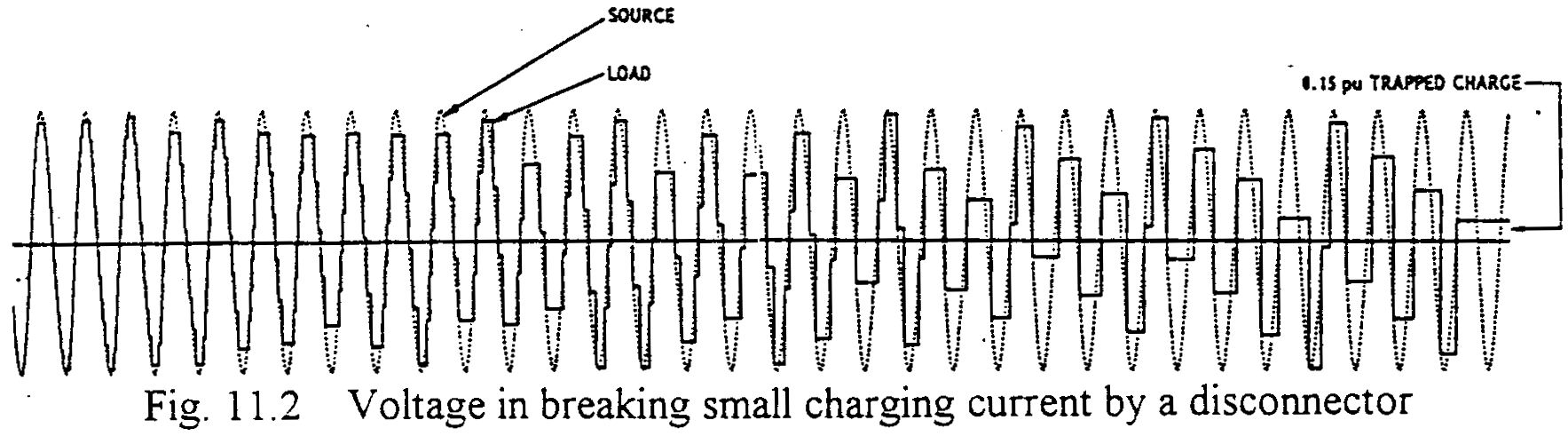
The magnitudes of the re-striking and the created surge voltages are important because of the following two reasons.:
-
a) Might be creating flash-over faults between the contacts and the grounds (due to the surge voltage applications during hot conditions)
b) Induced surge voltages in low voltage control circuits
Fig. 11.3 shows the final part of the current interruption in detail. Introducing the abbreviations followed, equations (11)---(15) are obtained. (For details, see the attached literature.)
-
Assumptions --- Every value is normalized
es: Source voltage
eL: Load side (capacitance) voltage
e1,e2: Restriking (discharging) voltages of positive and negative polarities
a: Asymmetry (See equation (11))
V : Contact separation velocity
s: Standard deviation of the restriking voltage scatterings
Etr: Trapped voltage
n : Number in cycles of source voltage
-
a=(e1-e2)/e2
-
For a=0
E0=- a
E1=E0+(1+0.5V)-(1+V)(1+a)
=-2a-0.5V-a
En=-(n+1) a-0.5nV-0.5n(n+1)aV ---- (12)
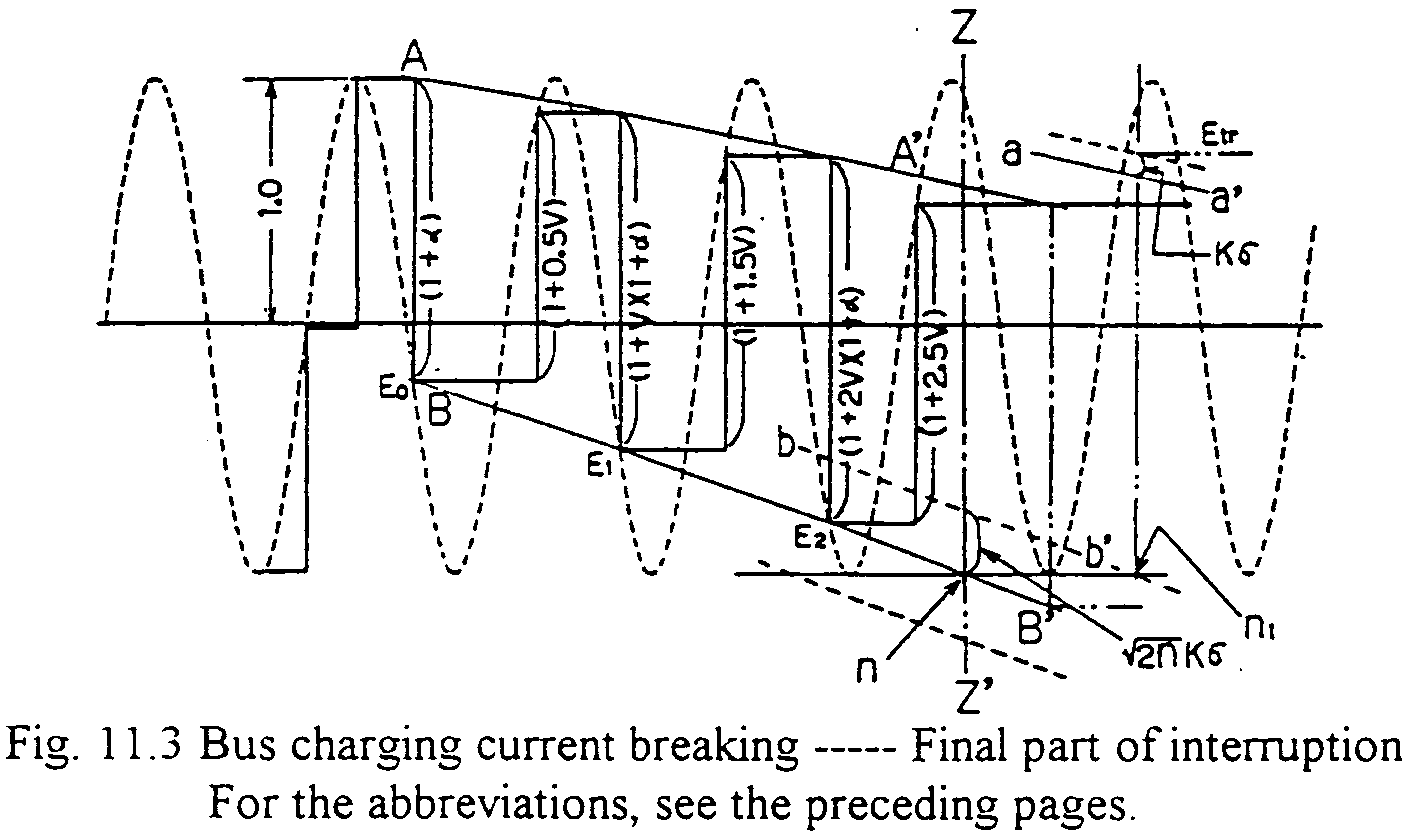
At ZZ', En= -1, and assuming that n can be continuous number, then,

As for the scatterings, it can be said that the scattering of a value consists of n numbers with scatterings of s is square root n times s, then as the effect of the scatterings, n is shifted to n1 such as,

-
Etr=a+n1V+ks --- (15)